


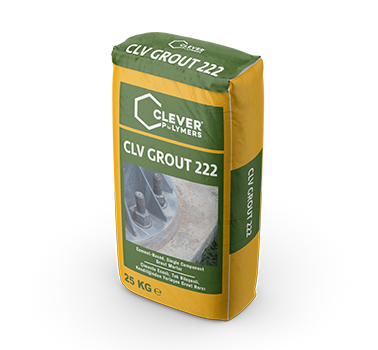
CLV GROUT 222
Cementitious, Single-Component, Self-Compacting Grout
CLV GROUT 222 is a single-component, cementitious, self-compacting grout.
• Mixed with water only. • Excellent flow properties. • High compressive strength. • Easy to prepare and apply. • No segregation. • Fire classification and protective properties similar to those of concrete. • Can be pumped or poured. • Good mechanical properties. • Expands in the plastic and early hardening stages. • Physical properties are not affected by weather conditions throughout the service life. • Provides high adhesion to concrete and reinforcement. • Watertight. • Resistant to oils. Meets the requirements of class EN 1504-3/R4 Meets the requirements of EN 1504-6

FEATURES AND BENEFITS
-
• Mixed with water only. • Excellent flow properties. • High compressive strength. • Easy to prepare and apply. • No segregation. • Fire classification and protective properties similar to those of concrete. • Can be pumped or poured. • Good mechanical properties. • Expands in the plastic and early hardening stages. • Physical properties are not affected by weather conditions throughout the service life. • Provides high adhesion to concrete and reinforcement. • Watertight. • Resistant to oils. Meets the requirements of class EN 1504-3/R4 Meets the requirements of EN 1504-6
APPLICATION NOTES
-
• If other machines are operating near the machine to be grouted, the extent to which ambient vibrations are transmitted must be determined by observing the vibration on the surface of a container full of water placed on the base plate. If necessary, the operating machines must be shut down until the grout has set (at least 10–12 hours at +20 °C).
• The application thickness must be 10–75 mm per layer. If thicker applications are required, 5–10 mm fine gravel may be added for thicknesses up to 100 mm, and 5–15 mm fine gravel for thicknesses up to 150 mm.
• The washed, clean gravel added must not exceed half the quantity of CLV GROUT 222. If additional gravel (preferably natural gravel) is added, flowability may decrease and, owing to the lower cement content, strengths may decrease by 20–40%.
• Curing must not be neglected after application.
• Do not use for patch-type surface repairs.
• Do not use vibrators.
• Do not apply where there is a risk of frost.
• Pour or pump from one side only.
Product Details
25 kg kraft paper bag
Shelf life is 6 months from the date of production. Store correctly in the original, unopened and undamaged packaging in dry conditions at between +5 °C and +30 °C.
| PROPERTY | TEST METHOD | VALUE |
|---|---|---|
| Chemical Base | Clever Lab. | Cement-based, special additives |
| Shelf Life | Clever Lab. | 6 months |
| Appearance / Colour | Clever Lab. | Powder, grey |
| Density | Clever Lab. | 2.2–2.4 kg/L |
| Mixing Ratio | Clever Lab. | 3.0–4.4 L water per 25 kg |
| Compressive Strength (1 day) | EN 196 | 30–40 N/mm² |
| Compressive Strength (7 days) | EN 196 | 50–60 N/mm² |
| Compressive Strength (28 days) | EN 196 | 65–95 N/mm² |
| Working Time | Clever Lab. | 35–40 min (+25 °C) |
| Setting Time | Clever Lab. | 24 h (+25 °C) |
| Final Strength (reached after) | Clever Lab. | 28 days (+25 °C) |
| Chloride Ion Content | EN 1015-17 | ≤0.05% |
| Expansion | Clever Lab. | 0.25%–0.50 |
| Modulus of Elasticity in Compression | EN 13412 | 20 GPa |
| Flexural Strength | EN 196 | ~8 N/mm² |
| Bond Strength | EN 1542 | >2 N/mm² |
| Capillary Absorption | EN 13057 | <0.5 kg/(m²·h⁰·⁵) |
| Application Thickness | Clever Lab. | 10–80 mm |
| Substrate Temperature | Clever Lab. | +5 °C to +30 °C |
| Service Temperature | Clever Lab. | −20 °C to +400 °C |
Application
• SURFACE PREPARATION
The concrete substrate must be clean and sound, with adequate compressive strength (at least 25 N/mm²) and a pull-off strength of at least 1.5 N/mm². The surface must be free from foreign matter such as oil, coatings and surface curing compounds, and must be clean and dry. Steel: Surfaces must be clean and free from grease, oil, rust and cutting swarf. Formwork: All formwork must be of adequate strength, coated with release oil and sealed to prevent leakage. Formwork must be made of sound material that will neither absorb water from the grout nor leak, and must be installed so as to withstand the forces encountered during the operation. On the pouring side, a pouring gap of approx. 5 cm must be left between the edge of the base plate and the formwork. It may be necessary to take measures such as using equipment like pumps or pipes to help the grout spread, or pre-wetting the surface of the foundation concrete. The edges of the formwork must be free from gaps to prevent leakage and loss of pressure.
• MIXING
Pour the appropriate quantity of water for the CLV GROUT 222 mix into a clean mixing bucket using a measuring container, add the product gradually and mix for 3–4 minutes with a 400–600 rpm mixer until a homogeneous, lump-free mix is obtained. Allow to stand for approx. 4 minutes and remix for 30 seconds; the material is then ready for use.
Pour the prepared grout continuously from one side of the formwork only, so that the application thickness per layer is 10–75 mm. Depending on the grouting details, thicker applications can be made in 2 or 3 layers; to prevent air from becoming trapped inside the formwork, pouring from two sides must be avoided. To ensure that all voids inside the formwork are filled, place the grout using a steel wire with a hooked end; do not use a vibrator. Formwork must not be removed earlier than 18–24 hours after application. Large surfaces exposed to the atmosphere, especially in hot, dry or windy conditions, must be protected against rapid evaporation for 24–48 hours with wet hessian, water or special curing compounds.
• If other machines are operating near the machine to be grouted, the extent to which ambient vibrations are transmitted must be determined by observing the vibration on the surface of a container full of water placed on the base plate. If necessary, the operating machines must be shut down until the grout has set (at least 10–12 hours at +20 °C).
• The application thickness must be 10–75 mm per layer. If thicker applications are required, 5–10 mm fine gravel may be added for thicknesses up to 100 mm, and 5–15 mm fine gravel for thicknesses up to 150 mm.
• The washed, clean gravel added must not exceed half the quantity of CLV GROUT 222. If additional gravel (preferably natural gravel) is added, flowability decreases; owing to the lower cement content, strength may decrease by 20–40%.
• Curing must not be neglected after application.
• Do not use for patch-type surface repairs.
• Do not use vibrators.
• Do not apply where there is a risk of frost.
• Pour or pump from one side only.