


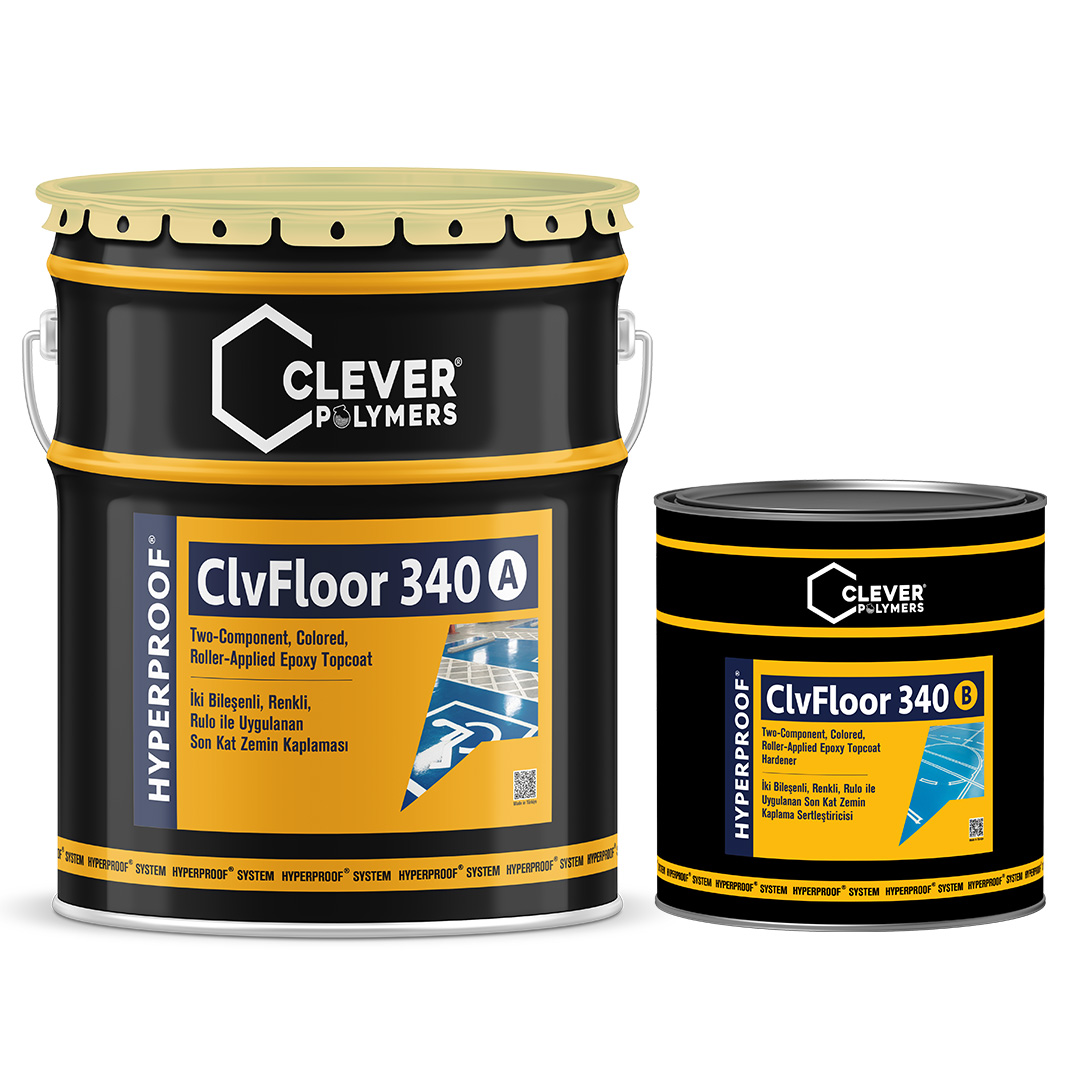
ClvFloor 340
Two-Component, Roller-Applied, Textured, Solvent-Free Epoxy Top Coat
ClvFloor 340 is a two-component, economical, coloured epoxy floor coating applied as a top coat.
• Liquid-tight
• Glossy surface
• High resistance to chemical attack and mechanical abrasion
• Easy to apply
• Easily applied by roller
• Smooth or slip-resistant finish options

FEATURES AND BENEFITS
-
• Liquid-tight
• Glossy surface
• High resistance to chemical attack and mechanical abrasion
• Easy to apply
• Easily applied by roller
• Smooth or slip-resistant finish options
FIELDS OF APPLICATION
-
• Concrete substrates subject to normal-to-medium loads
• Cement mortar substrates
• Storage areas
• Assembly areas
• Maintenance workshops
• Garages
• Loading ramps
• Multi-storey car parks
• Underground car parks
• Maintenance hangars
• Wet process areas in the beverage industry
• Wet process areas in the food industry
Product Details
Component A 18.96 kg metal pail Component B 5.04 kg metal pail Components A and B 24 kg kit Available in a wide range of colours.
24 months from production date.
Storage Conditions: Store correctly in the original, unopened and undamaged packaging in a dry place at between +5 °C and +30 °C.
Relative Humidity: max. 80% Application Temperature: min. +10 °C / max. +30 °C Substrate Temperature: min. +10 °C / max. +30 °C Substrate Moisture Content: the moisture content must be max. 4%. (If the moisture content exceeds 4%, ClvSeal EP PRIMER 625 can be applied as a moisture-barrier primer.)
For the technical data of this product, please refer to the Technical Data Sheet or contact our Technical Department.
Application
• SURFACE PREPARATION
The concrete substrate must be clean and sound, with sufficient compressive strength (at least 25 N/mm²) and a pull-off strength of at least 1.5 N/mm². The surface must be clean, dry and free from foreign matter such as dirt, oil, coatings and surface curing compounds. Concrete substrates must be prepared using abrasive equipment to remove cement laitance and achieve an open-textured surface. Weak concrete must be removed, and blowholes and voids must be fully opened up. Surface repairs, filling of blowholes and voids, and levelling of the surface must be carried out with suitable products from the CLV Repair and CLV Seal EP Repair ranges. To ensure full anchorage of the coating system to the substrate, anchor grooves must be cut at edges, corners and junctions, and along the edges of drain outlets and drains.
• MIXING
Before starting mixing, pre-mix component A mechanically in its own container until homogeneous. Then add component B to component A and mix continuously for approx. 3 minutes until a uniform mix is obtained. To ensure that the mix is completely homogeneous, transfer the material to a clean container and mix again to obtain a uniform mix. Avoid over-mixing to prevent air from being drawn into the mix. ClvFloor 340 must be thoroughly mixed using a low-speed (300–400 rpm) electric mixer or other suitable equipment. For mortar preparation, rotating-pan, flat-type or trough-type mixers should be preferred. Free-fall (concrete-mixer type) mixers are not suitable, as they cannot achieve the required homogeneity.
Primer application: When applying the primer, ensure that the surface is completely covered and that no pores remain. If necessary, a second coat of primer can be applied. ClvSeal EP PRIMER 151/617/625 can be applied by brush, roller or pin rake. For best results, spreading with a pin rake followed by back-rolling is recommended. Levelling mortar application: If the floor is rough, the surface must be levelled before painting. For this purpose, ClvSeal EP PRIMER 151 / 617 / 625 can be used in mortar form. For detailed mixing and application information, refer to the Technical Data Sheet of the relevant product. Paint application: ClvFloor 340 is applied as a paint coat with a short-pile roller. To ensure full coverage, application must be carried out crosswise, i.e. in two different directions. Scratch coat application: The scratch coat is first spread evenly over the surface with a squeegee. The surface is then rolled over with a short-pile roller to obtain a uniform appearance.
• If heating is required, appliances burning gas, oil, diesel or paraffin must never be used. • Only electric warm/hot-air blower systems should be used. • Do not apply on substrates with rising damp. • The fresh coating must be protected from damp, condensation and water for the first 24 hours. • Thin coatings cannot be applied on dirty or uneven surfaces; therefore, the floor and its surroundings must be cleaned thoroughly before application. • For colour consistency, the product for each area should be taken from the same batch number. • In conjunction with underfloor heating systems or high ambient temperatures, point loads may cause indentations in the resin surface