


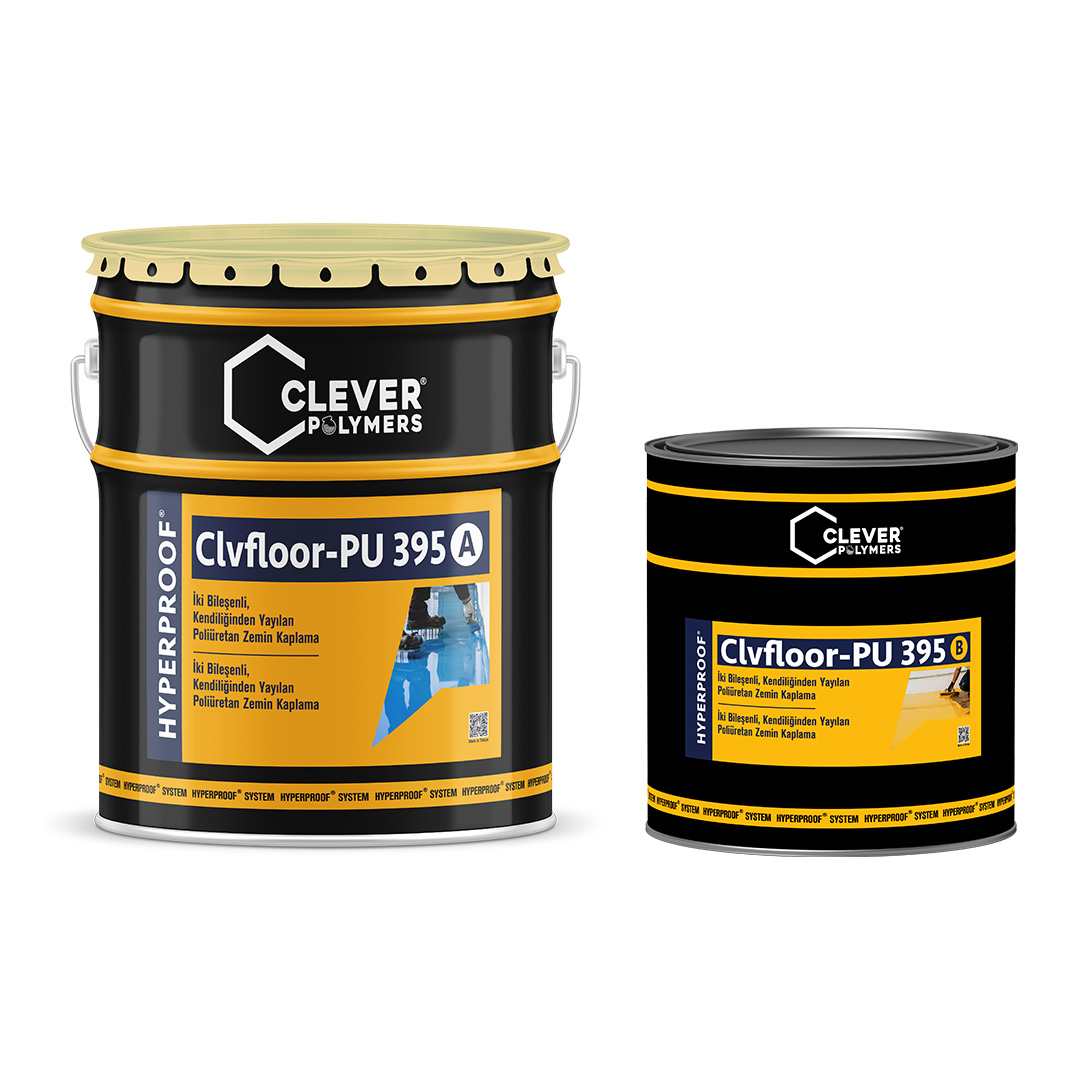
ClvFloor PU 395
Polyurethane-Based, Two-Component, Solvent-Free, Semi-Elastic, Self-Levelling Floor Coating
ClvFloor PU 395 is a solvent-free, very low-VOC, elastic, self-levelling, two-component polyurethane floor coating.
• Low VOC
• Self-levelling properties
• High mechanical strength
• Abrasion-resistant
• Long-lasting
• Smooth, homogeneous and aesthetic
• Easy maintenance and hygiene
• Permanent elasticity and crack bridging
FEATURES AND BENEFITS
-
• Low VOC
• Self-levelling properties
• High mechanical strength
• Abrasion-resistant
• Long-lasting
• Smooth, homogeneous and aesthetic
• Easy maintenance and hygiene
• Permanent elasticity and crack bridging
FIELDS OF APPLICATION
-
• Educational facilities • Healthcare facilities • Commercial premises • Museums • Lobbies • Entrance halls • Residential buildings • Aircraft hangars • Car parks Suitable for indoor use only.
Product Details
Component A (liquid): 24.60 kg metal pail Component B (liquid): 5.40 kg metal pail A+B kit: 30 kg kit
12 months from the date of production. Storage conditions: store correctly in the original, unopened and undamaged packaging in a dry place between +5 °C and +30 °C. Protect from direct sunlight.
| Property | Test Method | Value |
|---|---|---|
| Chemical Base | Clever Lab. | Polyurethane |
| Shelf Life | Clever Lab. | 12 months from production date |
| Appearance / Colour | Clever Lab. | Available in a wide range of colours. |
| Density | Clever Lab. | Comp. A: ~1.66 kg/L Comp. B: ~1.24 kg/L Comp. A+B: ~1.54 kg/L |
| Product Temperature | Clever Lab. | +10 °C to +30 °C |
| Ambient Temperature | Clever Lab. | +10 °C to +30 °C |
| Packaging | Clever Lab. | A: 24.60 kg B: 5.40 kg A+B: 30 kg |
| Mixing Ratio | Clever Lab. | A:B = 82:18 (by weight) |
| Working Time | Clever Lab. | Temperature / Time: +23 °C ~30 min |
| Foot Traffic | Clever Lab. | 16 h |
| Waiting Time between Coats | Clever Lab. | 12 h min. – 3 days max. |
| Applied Product Ready for Use | Clever Lab. | 7 days / +23 °C |
| Time to Traffic | Clever Lab. | 7 days / +23 °C |
Application
• SURFACE PREPARATION
Cementitious surfaces of structures in contact with water must be sound, dry, load-bearing, dust-free and clean, and also level. The substrate must be thoroughly cleaned of all oil, grease, rust and paraffin residues that would impair adhesion, and there must be no loose particles on the surface.
• MIXING
Mixing ratio: Component A : Component B = 4.36 kg : 0.64 kg (by weight) Gradually add component B to component A and mix with a mixer at 400–600 rpm for 3–5 minutes until a homogeneous mix is obtained. Allow to stand for approx. 3–5 minutes and mix again for 30 seconds; the material is then ready for use.
• APPLICATION
Before starting the application, mix component A thoroughly on its own with a mechanical mixer. Then add component B to component A and continue mixing for approx. 3 minutes until a completely uniform mix is obtained. During mixing, use low-speed mixers operating at 300–400 rpm to prevent air from being drawn into the mix. Brush, roller or airless spray equipment can be used for application.
• Working and reaction times of resin-based systems are affected by ambient and substrate temperature and by relative humidity. Low temperatures slow down the chemical reaction and extend the overcoating time and working time. At the same time, consumption increases as viscosity rises.
• High temperatures accelerate the chemical reaction, and the times given above are shortened accordingly. To allow the material to cure fully, the ambient and substrate temperatures must not fall below the minimum permitted temperature.
• Limited UV resistance.
• For exterior applications, the applied surface must be protected for the first 24 hours from weather conditions such as sun, wind, frost and rain.
• For applications in cold weather, condition the packaging at +20 °C to +25 °C before use to maximise the workability of the material.
• If the substrate temperature is below +5 °C or above +30 °C, wait for suitable temperatures.