


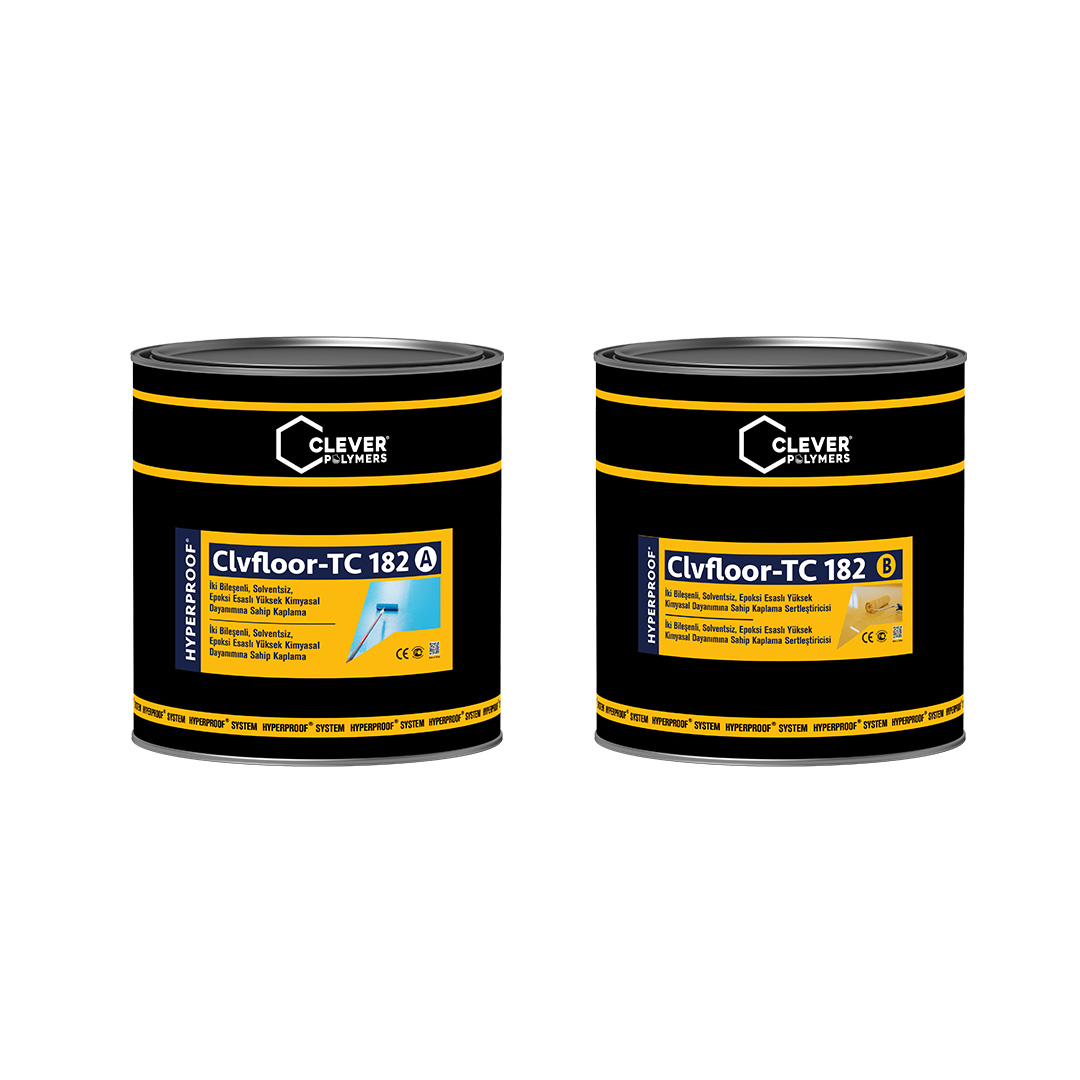
ClvFloor TC 182
Two-Component, Solvent-Free, Epoxy-Based Protective Coating
ClvFloor TC 182 is a two-component, epoxy-based protective coating developed especially for the protection of concrete.
• High chemical resistance. • A glossy surface. • Forms a surface structure that inhibits the growth of micro-organisms. • Easy to clean; provides a hygienic environment. • High mechanical strength. • Good chemical resistance. • Antibacterial. • Watertight. • Elasticity capable of absorbing movement in metal substrates. • Solvent-free. • Certified as suitable for contact with drinking water according to BS 6920-1.

FEATURES AND BENEFITS
-
• High chemical resistance. • A glossy surface. • Forms a surface structure that inhibits the growth of micro-organisms. • Easy to clean; provides a hygienic environment. • High mechanical strength. • Good chemical resistance. • Antibacterial. • Watertight. • Elasticity capable of absorbing movement in metal substrates. • Solvent-free. • Certified as suitable for contact with drinking water according to BS 6920-1.
FIELDS OF APPLICATION
-
• Concrete tanks • Walls: gas and vapour barrier for resistance to chemicals • Power stations, sugar factories, hangars and liquid storage areas • Drinking water tanks • Oil and fuel storage tanks • Petroleum refineries and paper mills • Beer, wine and fruit juice industry • Milk, cheese and yoghurt production facilities • Pharmaceuticals, paint, paper, batteries and freezers • Laboratories, hospitals, wet rooms and areas requiring hygienic conditions • Vertical and horizontal applications, indoors and outdoors
Product Details
0.20–0.40 kg/m² Approximate consumption per coat. Apply in two coats. To achieve the performance properties, the total dry film thickness must be min. 400 µm.
Component A (liquid): 4.36 kg metal pail Component B (liquid): 0.64 kg metal pail A+B kit: 5 kg kit
12 months from the date of production. Storage conditions: store correctly in the original, unopened and undamaged packaging in a dry place between +5 °C and +30 °C. Protect from direct sunlight.
| Property | Test Method | Value |
|---|---|---|
| Material Base | Clever Lab. | Epoxy |
| Shelf Life | Clever Lab. | 12 months from production date |
| Appearance / Colour | Clever Lab. | RAL 7032 (pebble grey) |
| Density | Clever Lab. | 1.05 kg/L |
| Product Temperature | Clever Lab. | +10 °C to +30 °C |
| Ambient Temperature | Clever Lab. | +10 °C to +30 °C |
| Packaging | Clever Lab. | 4.36 kg A 0.64 kg B 5.00 kg kit |
| Working Time | Clever Lab. | 45 min / +23 °C |
| Curing Time | Clever Lab. | Initial curing time: min. 12 h / +23 °C Full cure: min. 7 days / +23 °C |
| Consumption | Clever Lab. | 0.20–0.40 kg/m² (per coat) Total dry film thickness: min. 400 µm |
| Time to Traffic | Clever Lab. | Foot traffic after 24 h at +23 °C |
| Waiting Time between Coats | Clever Lab. | 12–18 h (+23 °C) +23 °C do not exceed 24 h +35 °C do not exceed 16 h |
Application
• SURFACE PREPARATION
Cementitious surfaces of structures in contact with water must be sound, dry, load-bearing, dust-free and clean, and also level. The substrate must be thoroughly cleaned of all oil, grease, rust and paraffin residues that would impair adhesion, and there must be no loose particles on the surface.
• MIXING Mixing Ratio:
Component A : Component B = 4.36 kg : 0.64 kg (by weight). Slowly add component B to component A and mix with a mixer at 400–600 rpm for 3–5 minutes until a homogeneous mix is obtained. After leaving to mature for approx. 3–5 minutes and mixing again for 30 seconds, the material is ready for use.
• APPLICATION
Before starting the application, mix component A thoroughly on its own with a mechanical mixer. Then add component B to component A and continue mixing for approx. 3 minutes until a completely uniform mix is obtained. During mixing, use low-speed mixers operating at 300–400 rpm to prevent air from being drawn into the mix. Brush, roller or airless spray equipment can be used for application.
• Working and reaction times of resin-based systems are affected by ambient and substrate temperature and by relative humidity. Low temperatures slow down the chemical reaction and extend the overcoating time and working time. At the same time, consumption increases as viscosity rises.
• High temperatures accelerate the chemical reaction, and the times given above are shortened accordingly. To allow the material to cure fully, the ambient and substrate temperatures must not fall below the minimum permitted temperature.
• Limited UV resistance.
• For exterior applications, the applied surface must be protected for the first 24 hours from weather conditions such as sun, wind, frost and rain.
• For applications in cold weather, condition the packaging at +20 °C to +25 °C before use to maximise the workability of the material.
• If the substrate temperature is below +5 °C or above +30 °C, wait for suitable temperatures.