


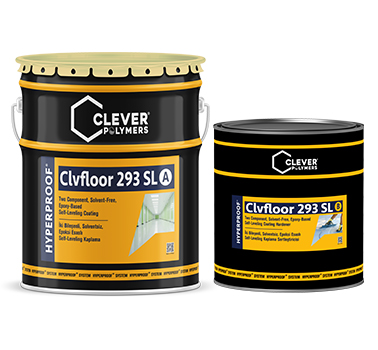
ClvSeal 293 SL
Two-Component, Self-Levelling, Solvent-Free Epoxy Floor Coating
ClvFloor 293 SL is a two-component, epoxy resin-based, solvent-free, coloured, self-levelling coating material.
• Excellent chemical and mechanical resistance.
• Low VOC content.
• High strength under medium to heavy loads.
• Good abrasion resistance.
• Easy to apply.
• Easy to maintain and clean.
FEATURES AND BENEFITS
-
• Excellent chemical and mechanical resistance.
• Low VOC content.
• High strength under medium to heavy loads.
• Good abrasion resistance.
• Easy to apply.
• Easy to maintain and clean.
FIELDS OF APPLICATION
-
• In areas with medium to heavy industrial loads
• On concrete and cement-based substrates
• Warehouses
• In production areas
• In the chemical, pharmaceutical and food industries
• In shops and supermarkets
• Aircraft hangars
• In car parks
Product Details
~0.3–0.5 kg/m² (when used as a paint top coat)
~0.9–1.2 kg/m² (when used as a self-levelling main coat)
Component A: 18.96 kg Metal Pail Component B: 5.04 kg Metal Pail Components A and B: 24 kg Kit Available in a wide range of colours
Store the product in its unopened original packaging at temperatures between +5 °C and +25 °C for a maximum of 12 months. Once opened, use the product as soon as possible.
| PROPERTY | TEST METHOD | VALUE |
|---|---|---|
| Chemical Base | Clever Lab. | Epoxy |
| Shelf Life | Clever Lab. | 24 months from date of production |
| Appearance / Colour | Clever Lab. | Component A: coloured liquid Component B: transparent liquid Available in a wide range of colours |
| Density | DIN EN ISO 2811-1 | Mixed: 1.44 kg/L Filled mix (1:1): 1.84 kg/L |
| Mixing Ratio | Clever Lab. | A:79 / B:21 |
| Solids Content | Clever Lab. | 100% |
| Consumption | Clever Lab. | Top coat (paint): 0.3–0.5 kg/m² Self-levelling main coat: 0.9–1.2 kg/m² |
| Working Time | Clever Lab. | Temperature / Pot Life: +10 °C ~60 min +20 °C ~30 min +30 °C ~15 min |
| Waiting Time between Coats | Clever Lab. | +10 °C: 30 h – 3 days +20 °C: 24 h – 2 days +30 °C: 16 h – 1 day |
| Time to Traffic | Clever Lab. | +10 °C: 72 h – 6 days – 10 days +20 °C: 24 h – 4 days – 7 days +30 °C: 18 h – 2 days – 5 days |
| Abrasion Resistance | BS 8204-2 | ~35 mg (CS10/1000/1000) (7 days / +23 °C) |
| Compressive Strength | EN 13892-2 | ~50 N/mm² (resin filled 1:0.9 / 28 d / +23 °C) |
| Flexural Strength | Clever Lab. | ~20 N/mm² (resin filled 1:0.9 / 28 days / +23 °C) |
| Pull-off Adhesion Strength | Clever Lab. | >1.5 N/mm² (concrete failure) |
| Chemical Resistance | Clever Lab. | Resistant to many aggressive chemicals. Please consult the Clever Polymers Technical Department. |
| Resistance to Heat Ageing | Clever Lab. | Short-term (max. 7 days): +80 °C Short-term (max. 12 h): +100 °C |
| Reaction to Fire | EN 13501-1 | Bfl-s1 |
Application
• SURFACE PREPARATION
The concrete substrate must be clean and sound, with sufficient compressive strength (at least 25 N/mm²) and a pull-off strength of at least 1.5 N/mm². The surface must be free from foreign matter such as oil, coatings and surface curing compounds, and must be clean and dry. Concrete substrates must be prepared using abrasive equipment to remove cement laitance and achieve an open-textured surface. Weak concrete must be removed, and blowholes and voids must be fully opened up. Surface repairs, filling of blowholes and voids, and levelling of the surface must be carried out with suitable CLV Repair products. To ensure full anchorage of the coating system to the substrate, anchor grooves must be cut at edges, corners and junctions, and around the edges of features such as drain outlets and drains.
• APPLICATION
First mix component A thoroughly on its own using mechanical means. Then add component B to component A and mix continuously for approx. 3 minutes until a homogeneous mix is obtained. Depending on the condition of the surface to be coated, add quartz sand filler at 30–50% of the total resin mix. Continue mixing for a further 2 minutes. Transfer the material to another container and mix again. Avoid over-mixing to reduce the formation of air bubbles. Mix with a low-speed (300–400 rpm) electric mixer or other suitable equipment. For mortar preparation, use rotating-pan, trough-type or flat-type mixers. Levelling mortar: Rough surfaces must first be levelled. ClvSeal EP PRIMER primers can be applied as a levelling mortar (see the Technical Data Sheet). Smooth wear layer: ClvFloor 293 SL is poured onto the surface and spread with a notched trowel. After spreading the material evenly over the surface, turn the notched trowel round and smooth the surface to achieve a finish of higher aesthetic quality. Sand-textured system: ClvFloor 293 SL is poured onto the surface and spread with a notched trowel. A spiked roller is then passed over it to release entrapped air. After approx. 15 minutes (at +20 °C), but before 30 minutes have elapsed (at +20 °C), apply a light broadcast of quartz sand, followed by a full broadcast to excess.
Do not apply ClvFloor 293 SL to surfaces with rising damp. If the system consists of a primer and a top coat, do not broadcast sand onto the primer. Freshly applied ClvFloor 293 SL must be protected from damp, condensation and water for at least 24 hours. For roller-applied / textured coatings: Uneven surfaces, as well as contaminated areas, cannot and must not be covered with thin coatings. Therefore, both the substrate and the adjacent areas must always be prepared and thoroughly cleaned before application. Failure to assess and treat cracks correctly may reduce the service life and cause the cracks to reflect through the coating. For exact colour matching, ensure that each area is coated with ClvFloor 293 SL from the same production batch number. Under certain conditions, high point loads combined with underfloor heating systems or high ambient temperatures may cause marks in the resin. If heating is required, do not use gas, oil, paraffin or other fossil-fuel heaters; these produce large amounts of CO2 and H2O water vapour, which may affect the surface appearance. Use only electric warm-air blower systems for heating.