


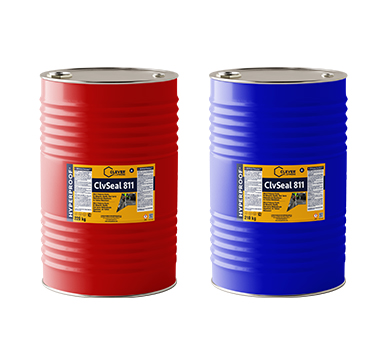
ClvSeal 811
2-Component, Elastic Hybrid Polyurea Waterproofing Applied with Special Spray Machines
ClvSeal 811 is a two-component, elastic, fast-curing polyurethane/polyurea hybrid membrane with crack-bridging properties. It can only be applied with a special machine.
• Solvent-free.
• Puncture-resistant.
• Used in permanent contact with water.
• Seamless waterproofing application.
• Good adhesion to many substrates.
• Water vapour permeability – allows the substrate to breathe.
• Low viscosity.
• Does not soften at high temperatures.
• Remains elastic at low temperatures.
• High elasticity and crack bridging.
• Excellent crack-covering properties.

FEATURES AND BENEFITS
-
• Solvent-free.
• Puncture-resistant.
• Used in permanent contact with water.
• Seamless waterproofing application.
• Good adhesion to many substrates.
• Water vapour permeability – allows the substrate to breathe.
• Low viscosity.
• Does not soften at high temperatures.
• Remains elastic at low temperatures.
• High elasticity and crack bridging.
• Excellent crack-covering properties.
FIELDS OF APPLICATION
-
• As a waterproofing membrane on flat and pitched roofs, with a UV-protective top coat
• As a waterproofing membrane beneath planting and complex details
• As a waterproofing membrane on concrete structures without traffic loads, when a UV-protective top coat is applied
Product Details
Total consumption (for 2 mm thickness): 2.0 kg/m²
Component A: 220 kg drum; Component B: 210 kg drum. Component A (ISO): transparent/brown; Component B (resin): grey or yellowish. Mix: grey ~ RAL 7004
Component A: 9 months from the date of production. Component B: 9 months from the date of production. Store correctly in the original, unopened and undamaged packaging in dry conditions at between +5 °C and +30 °C. Higher temperatures will shorten the shelf life of the product. For further information, refer to the Safety Data Sheet (SDS).
• Relative humidity: max. 80% RH • Substrate temperature: +8 °C min. / +55 °C max. Must be at least ≥ +3 °C above the dew point • Temperature: +8 °C to +50 °C • Relative humidity: <85%
| Substrate | Surface Preparation | Primer |
|---|---|---|
| Cementitious substrates | If req., light quartz sand broadcast 0.3–0.8 mm | ClvSeal EP PRIMER 617 |
| Unglazed ceramic tiles, cement screed | Mechanical cleaning; dust removal | ClvSeal EP PRIMER 617 |
| Bituminous membrane | Mech. cleaning; sound, dry substrate | PU UNIVERSAL PRIMER |
| Bituminous coating | Mech. cleaning; sound, dry substrate | PU UNIVERSAL PRIMER |
| Metal substrates (iron/galvanised steel, lead, copper, aluminium, brass, stainless steel) | Sanding or blasting; degreasing | PU UNIVERSAL PRIMER |
Note: For the waiting time/overcoating, refer to the data sheets of the relevant products. Other substrates must be tested for suitability.
| Property | Test Method | Value |
|---|---|---|
| Shore A Hardness | Clever Lab. | ~88 |
| Tensile Strength | DIN 53504 | ~17.0 N/mm² (28 d / +23 °C) |
| Elongation at Break | DIN 53504 | ~490% (28 days / +23 °C) |
| Crack-Bridging Ability | DIN EN 1062-7 | Dynamic: B 4.2; Static: A 5 |
| Root resistance | DIN 4062 | Resistant to root penetration |
| Reaction to fire | EN 13501-1; DIN EN ISO 11925-2 | Euroclass E |
| Chemical resistance | Clever Lab. | Gen. resistant to bitumen and alkalis |
| Heat resistance | Clever Lab. | −40 °C to +120 °C |
| Chemical base | Clever Lab. | Hybrid polyurea |
| Shelf life | Clever Lab. | 9 months from production date |
| Appearance / Colour | Clever Lab. | Component A: grey liquid; Component B: transparent liquid (may yellow under UV exposure) |
| Density (mixed) | Clever Lab. | ~1.05 g/cm³ |
| Tear strength | DIN 53515 | ~34.0 N/mm² |
| Rain resistance | Clever Lab. | ~5 min (+20 °C) |
| Foot traffic | Clever Lab. | ~5 min |
| Env. resist. (careful foot traffic) | Clever Lab. | ~18 min (+20 °C) |
Application
• SURFACE PREPARATION
Substrates must be sound, clean, dry and free from dirt, oil, grease, etc. and loose particles. Depending on their type, substrates must be mechanically cleaned and/or primed. Abrasive blasting must be carried out if necessary. Suitable substrates: concrete, bituminous membranes and coatings, metal substrates, ceramic finishes.
• MIXING
Dosing and mixing must be carried out with suitable 2-component spray equipment. The recommended product and hose temperatures must be observed. Recommended pressure: components A + B 160–180 bar. The accuracy of dosing and mixing must be checked regularly with the equipment.
• APPLICATION
Before application, determine and confirm that the substrate moisture, relative humidity and dew point conditions are suitable. For waiting time / top coat application, refer to the Technical Data Sheets of the relevant products. Other substrates must be tested for suitability. Damaged areas must be covered with tape or suitable materials. Waterproofing: Apply ClvSeal 811 with multi-component, heated, high-pressure metering spray equipment. UV coating: A single coat of ClvSeal PU 650 TC-1K is applied by roller or airless spray. For more detailed information, refer to the application methods.
• Application can only be carried out with plural-component hot-spray equipment. • Wear personal protective equipment during application. • Always use the tools and the mix in accordance with the manufacturer's instructions. • The product must be used by experienced professional applicators only. • Do not use ClvSeal 811 where substrate moisture has increased. • If application is carried out while the temperature is rising on substrates prone to outgassing, pinholes may form. • ClvSeal 811 is not to be applied in enclosed spaces. • ClvSeal 811 is not resistant to sunlight and changes colour when exposed to it. However, if exposure to UV radiation is limited to a maximum of 4 weeks, the product performance and technical properties are not affected. Therefore, ClvSeal 811 can be protected from these effects by applying a UV-protective top coat. • On wet surfaces, or where relative humidity is > 80% and air temperature is > +30 °C, PU UNIVERSAL PRIMER must be used as an adhesion promoter. • Note: Always carry out a trial application. • Product temperature Component A +70–80 °C Component B +65–70 °C Hose +65–70 °C